Susmaryosep! Taglish Is a Language, Fight Me 👊🏼


Taglish, that mix of Tagalog and English we all grew up switching between, is not a watered-down version of anything. For Buwan ng Wika, a look at the Filipino we kept, the Filipino we lost, and the noises our parents made when we broke something.
There's a specific look that crosses a Filipino-American face when someone asks, "Do you speak Tagalog?"
It's not a yes. It's not a no. It's a wince, a shrug, and then the phrase that half our community has memorized like a passcode: nakakaintindi ako, pero hindi ako marunong magsalita. I understand it, but I can't speak it.
Every August, the Philippines observes Buwan ng Wika, National Language Month. Here in Ohio it usually passes quietly, no parade, no poster contest, just August doing what August does. This year, that changes.
Wait, What Is Buwan ng Wika?
Fair question, especially if you grew up here.
Buwan ng Wika means Month of the Language, short for Buwan ng Wikang Pambansa, National Language Month. Every August, the Philippines spends four weeks celebrating Filipino, the national language.
The date isn't random, though it took a few tries. The celebration started in 1946 as Linggo ng Wika, Language Week, and originally landed in late March, timed to end on the birthday of the Tagalog poet Francisco Balagtas. Problem: that's summer break in the Philippines, so the schools, the entire point, were empty. In 1955 it moved to August 13 through 19, ending instead on the birthday of Manuel L. Quezon, the president who pushed hardest for the country to have a national language of its own rather than running itself in Spanish and English. That's why he's called the Father of the National Language. In 1997 it was stretched to the full month, presumably by someone who understood that Filipinos cannot do anything worth doing in only seven days.
In Philippine schools it's a whole production. Kids come in barong and baro't saya. There are poster contests, essay contests, and sabayang pagbigkas, choral recitation performed by an entire class in unison with alarming intensity. And for generations, the crown jewel was Balagtasan, a formal debate conducted entirely in rhyming verse, named after the poet Francisco Balagtas. Imagine a rap battle, in Tagalog, for a grade, with your parents watching. Ask anyone who grew up with it and you'll get a story.
This Year, Ohio Is Actually Noticing
Here's the update: for the first time ever, the City of Cleveland is throwing its own Buwan ng Wika celebration. Unang beses, first time ever, straight from City Hall, for a language most of us only half remember. The Community Relations Board is hosting it Monday, August 31st, 6 to 8pm, at City Hall Rotunda (601 E. Lakeside Ave).
Gusto mo sumama? Email Chia-Min Chen at cchen@clevelandohio.gov as soon as possible to get on the guest list and receive parking info and updates. Emphasis on soon, this is the kind of thing that fills up fast once the community hears about it, and we'd love a strong PASO turnout in that rotunda.
So no, this year August isn't passing quietly. Somebody's finally throwing it a party. Might as well show up and let them hear how we say hello.
The Vocabulary We Actually Kept
Here's the funny part. Almost nobody loses the language completely. We just keep an extremely specific portion of it.
We kept the food words. Kanin, ulam, sinigang, adobo, pancit, lechon. Nobody in the history of our community has ever forgotten the word merienda.
We kept the scolding words, because they arrived with volume and eye contact and a wooden spoon. Ano ba! Sus! Naku! You may not be able to conjugate a verb, but you know precisely what hoy means and exactly how fast you need to move.
We kept the endearments. Anak. Iho, iha. The way your name softens when someone who loves you says it in Tagalog.
And we kept po and opo, the little respect particles that turn any sentence into a bow. Plenty of us can't build a full sentence but will still reflexively attach po to the end of an English one when talking to an auntie. That's not broken Tagalog. That's a value system that survived the language it came in.
What went missing is everything in the middle. The small talk. The jokes. The part where you could say something complicated to your lola and have her understand exactly what you meant.
The Taglish Hall of Fame

Before we get precious about grammar, let's admit that Taglish has produced some of the finest sentences ever constructed by anyone.
"Nag-aano ka?" What are you doing? Except ano means "what," so the literal translation is closer to "are you whatting?" This is the single most useful word in the language. It's a verb, a noun, a placeholder, a stalling tactic, and an accusation, depending entirely on tone.
"Pahingi naman ng kaunti lang, promise." Just a little bit, I promise. Universally said while already reaching for the plate.
"Sandali lang." Just a second. Historically accurate range: forty seconds to one full hour.
"Bahala na." Come what may, it'll work out. A phrase that has been described as fatalism, faith, and a national personality trait, usually deployed after the deadline has already passed.
"Open the light." Not Tagalog at all, and yet. Because in Tagalog you buksan the light, and buksan means open. Millions of Filipino kids have opened a light and closed a light and never once been confused.
"Where are you now na?" and "Did you eat na?" The na is doing quiet work here that English has no equivalent for. It means already, yet, by now, and hurry up, simultaneously.
"Take home mo na yan." Take that home. Not a request. Not optional. You are leaving with the Tupperware and you will return it, someday, eventually, filled with something else.
"Kain tayo!" Let's eat, said to anyone within eyesight, including strangers, including people already eating. Not really an invitation. More of a reflex, and one of the warmest things in the language.
The Parental Exclamation, an Art Form
Then there's the sacred category: the noises our parents made when something went wrong.
Filipino parents were rarely going to swear in front of the kids. So the language developed an entire arsenal of swerves, near-misses, and holy invocations that let you release the pressure without ever saying the actual word.
"Susmaryosep!" The masterpiece. Jesus, Mary, and Joseph, spoken so fast the entire Holy Family compresses into three syllables. Deployed for dropped plates, bad report cards, and traffic. Also comes in the shortened field version, "Sus!", and the deluxe
"Hesusmaryosep!" for genuine emergencies.
"Anak ng pating!" Child of a shark. And here's the thing about all of these: they exist to dodge a very different word that starts the same way. Somewhere mid-sentence, a parent commits to a curse, remembers the children are in the room, and swerves hard into marine biology. There's a whole family of these, and every household has its own house brand. Anak ng tokwa, child of the tofu. Anak ng tinapa, child of the smoked fish.
"Naku!" and "Hay naku!" The workhorses. Short for ina ko, roughly "my mother," and usable for absolutely everything: mild concern, deep disappointment, mock outrage, or the sound of sitting down after a long day.
"Ay kabayo!" Oh, horse. A cousin of ay naku, and one of those exclamations that seems to run in specific families and specific provinces rather than everywhere at once. No one can fully explain the horse. That's part of its charm. If it was your mother's, you know the exact pitch she said it at, and you probably say it now without meaning to.
"Ano ba!" What even! Two syllables containing an entire lecture, and the exact tone determines whether you're in trouble or the traffic is.
"Aba!" Pure indignation. The sound of someone being disrespected in real time.
"Diyos ko po." My God. The reverent option, used when susmaryosep would be undignified, such as in church, or in front of your other grandmother.
"Leche!" Milk, in Spanish, which makes no sense until you learn it was a curse over there too. Four hundred years of colonial history preserved in a word your lolo yelled at a jeepney.
What's remarkable about this whole catalog is how much of it is inherited. Most of us can't hold a conversation in Tagalog, but we can produce a perfect susmaryosep under stress, with the exact intonation of the person we learned it from. The grammar goes first. The exclamations never leave.
That's a real form of fluency. Not the kind you can list on a resume, but the kind that means you'll always sound like your mother when you drop something.
Why It Slipped
It's tempting to feel bad about this, so let's be clear about how it happened, because it usually wasn't carelessness.
A lot of our parents made a deliberate choice. They came here in the sixties and seventies and after, and they had been taught, sometimes explicitly, that an accent was a liability. So they spoke English to their children on purpose. They wanted us to sound like we belonged in the classroom, the interview, the neighborhood. That decision came from love and from a fairly accurate reading of the country they had landed in.
There's an older layer to it too. The Philippines has been a place where language and power were tangled for centuries: Spanish in the churches and courts, then English in the schools, always the message that the local tongue belonged at home and the foreign one belonged in the world. Some of our families carried that hierarchy across the ocean without ever naming it out loud.
So if you grew up not speaking it, that isn't a personal failure. It's the residue of a very long history, and a parent making the best call they could with the information they had.
Taglish Is Not a Consolation Prize
Somewhere in the middle of all that, we built something new.
Nag-grocery ako kanina. Ang init naman today. Can you pass the sabaw? Taglish gets treated like a watered-down version of the real thing, the language equivalent of a participation trophy. It isn't. Switching between two languages mid-sentence and landing on your feet takes fluency in both. Every bilingual community on earth does some version of it, and linguists have a name for it, which is a polite way of saying it's a real thing and not a mistake.
More to the point, Taglish is honest. It's the sound of a community that belongs to two places at once and refuses to pick. Your lola switches too. Everybody switches. The pure form only exists in textbooks and in the imagination of people who feel bad about their own vocabulary.
Also, There Is Not Just One
Quick note for anyone about to feel guilty for not knowing "the" Filipino language: there are well over a hundred of them.
Tagalog became the base of the national language, but Cebuano, Ilocano, Hiligaynon, Bicolano, Waray, Kapampangan, Pangasinan, and dozens more are living tongues with their own literatures, jokes, and grandmothers. Plenty of Filipinos in the Philippines speak Tagalog as a second language, with just as much hesitation as we do. If your family's words sound nothing like what you hear in Tagalog movies, you didn't learn it wrong. You learned a different one.
The Good News About Starting Late

Language is the one piece of heritage you can go back for. You can't recover a decade you didn't spend in the Philippines. You can absolutely recover a vocabulary.
And the bar is lower than the shame around it suggests. You don't have to become fluent. You have to become brave enough to be bad at it in front of people who love you, which is harder but much faster.
A few places to start:
Ask for the story, not the translation. Don't ask your lola what a word means. Ask her what her mother used to call her, or what they said before a meal, or what the word for something was in her province. You'll learn more language in that conversation than in a month of flashcards, and you'll get the story permanently.
Answer in one word. When someone speaks to you in Tagalog and you reflexively answer in English, try just one word back. Oo. Sige. Salamat. It feels small. It changes the whole shape of the exchange.
Record them. Voice memos. Right now, while you can. Ask your parents and grandparents to tell a story in their own language and just let it run. Someday that recording will be worth more to you than almost anything else you own.
Let the kids hear it badly. If you're a parent waiting until your Tagalog is good enough to pass on, it will never be good enough. Kids don't need a fluent teacher. They need a household where the language is a normal sound.
What We're Really Keeping
Here's the thing about Buwan ng Wika. It's called Language Month, but no one is really campaigning for correct grammar.
What's actually being protected is a way of seeing. Kapwa, the idea that the person across from you shares your self. Bayanihan, the whole neighborhood lifting the house. Utang na loob, the debt of the inner self that isn't a debt at all. Tampo, that particular sulk that isn't quite anger and needs no explanation to anyone raised around it. These aren't vocabulary words. They're instructions for how to be with other people, and they came bundled inside a language.
You can carry those without perfect conjugation. Most of us do. But every word you get back is one more piece of the operating system, one more thing you can hand to whoever comes next.
Nakakaintindi ako, pero. I understand, but.
Let's work on the pero.
Taglish. You're It.
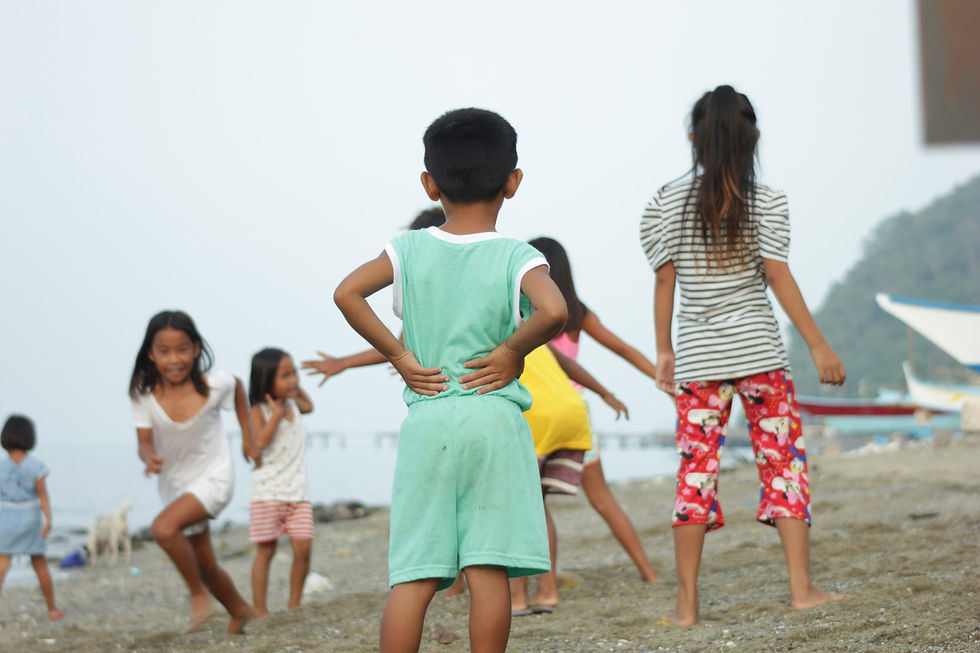
Every one of these got passed to somebody. A word, a wince, an exclamation you didn't choose and now can't stop saying. Somebody tagged you with it years ago, probably in a kitchen, probably at volume.
So now it's your turn.
What did your parents used to say that you catch yourself saying now? The swerve word. The sigh with a name. The phrase that comes out of your mouth in their exact pitch when you drop something. Drop it in the comments, spell it however your family spelled it, and tell us who you got it from.
We're collecting them. Because a language doesn't survive in a textbook. It survives in whoever says it next, so say it loud at City Hall on the 31st, 6 to 8pm, at City Hall Rotunda (601 E. Lakeside Ave), then come tell us about it in the comments.


Comments